.png)
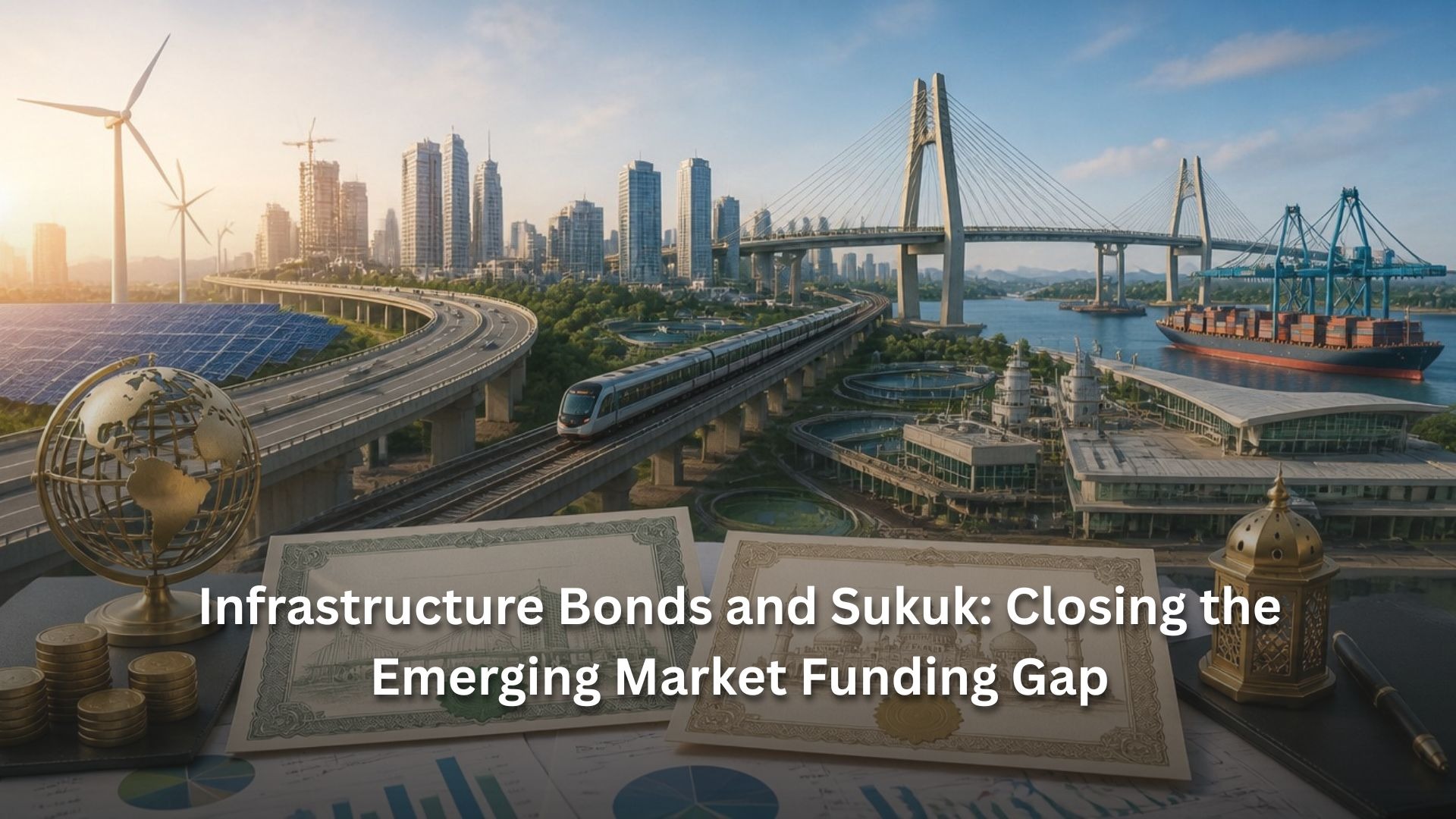
Table of Contents
Introduction
Emerging markets continue to face a major infrastructure financing gap. Governments alone cannot fund the roads, ports, renewable energy projects, airports, rail systems, and utilities required for long-term economic growth. As public budgets tighten and development needs increase, infrastructure bonds and infrastructure sukuk are becoming essential financing tools.
These instruments help connect long-term institutional capital from pension funds, insurers, sovereign wealth funds, and asset managers with infrastructure projects that generate stable, predictable cash flows over decades. With improved regulation, stronger credit enhancement mechanisms, and standardized deal structures, project bonds and sukuk are increasingly attracting global institutional investors.
Why Infrastructure Bonds and Sukuk Matter
Growing Infrastructure Financing Needs
Many emerging economies face a persistent gap between infrastructure investment requirements and available funding. Public-sector financing alone is insufficient, making private capital participation increasingly important.
Infrastructure bonds and sukuk provide an alternative funding channel that allows governments and project sponsors to access long-term capital markets while reducing dependence on short-term bank financing.
Strong Fit for Institutional Investors
Insurance companies and pension funds typically seek long-duration investments with predictable income streams that align with their liabilities. Well-structured infrastructure debt instruments offer:
- Stable long-term cash flows
- Lower volatility compared to equities
- Predictable repayment structures
- Portfolio diversification benefits
This makes infrastructure debt particularly attractive for institutional investors with long investment horizons.
Portfolio Diversification and Yield Potential
Infrastructure debt often provides higher yields than sovereign bonds while maintaining relatively defensive characteristics. Investors also benefit from exposure to essential economic assets such as transport, utilities, and energy infrastructure.
In addition, sustainable infrastructure projects increasingly align with ESG and impact-investment mandates, attracting both conventional and sustainability-focused capital.
How Infrastructure Bonds and Sukuk Are Structured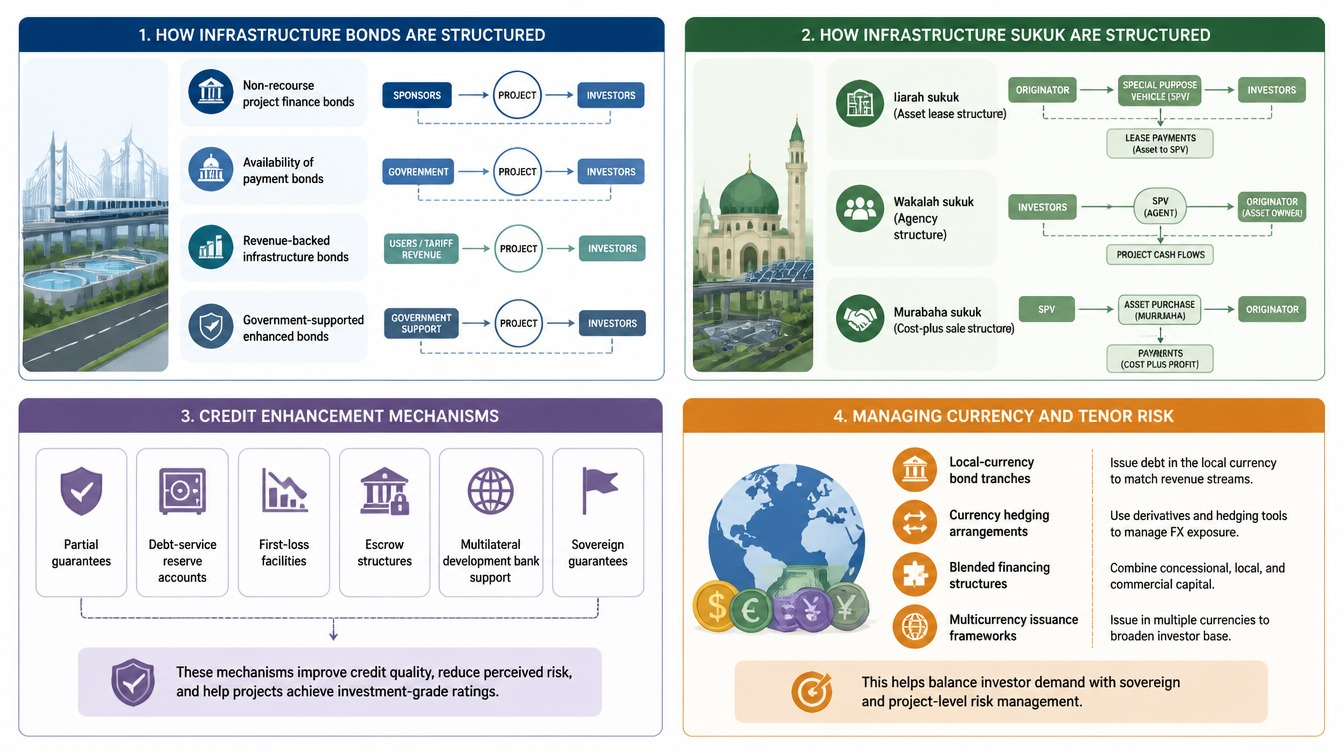
Project Bonds
Project bonds are debt instruments backed primarily by project-generated cash flows or availability payments from government entities. Common structures include:
- Non-recourse project finance bonds
- Availability of payment bonds
- Revenue-backed infrastructure bonds
- Government-supported enhanced bonds
These structures are designed to allocate risk efficiently between sponsors, governments, contractors, and investors.
Infrastructure Sukuk
Infrastructure sukuk are Sharia-compliant investment certificates linked to underlying infrastructure assets or lease-based cash flows. Common sukuk structures include:
- Ijarah sukuk
- Wakalah sukuk
- Murabaha sukuk
These structures enable Islamic and conventional investors to participate in infrastructure financing while complying with Sharia principles.
Credit Enhancement Mechanisms
Credit enhancement plays a critical role in attracting institutional capital. Common tools include:
- Partial guarantees
- Debt-service reserve accounts
- First-loss facilities
- Escrow structures
- Multilateral development bank support
- Sovereign guarantees
These mechanisms improve credit quality, reduce perceived risk, and help projects achieve investment-grade ratings.
Managing Currency and Tenor Risk
Emerging-market infrastructure financing often faces foreign exchange risk due to revenue and debt mismatches. Issuers commonly address this through:
- Local-currency bond tranches
- Currency hedging arrangements
- Blended financing structures
- Multicurrency issuance frameworks
This helps balance investor demand with sovereign and project-level risk management.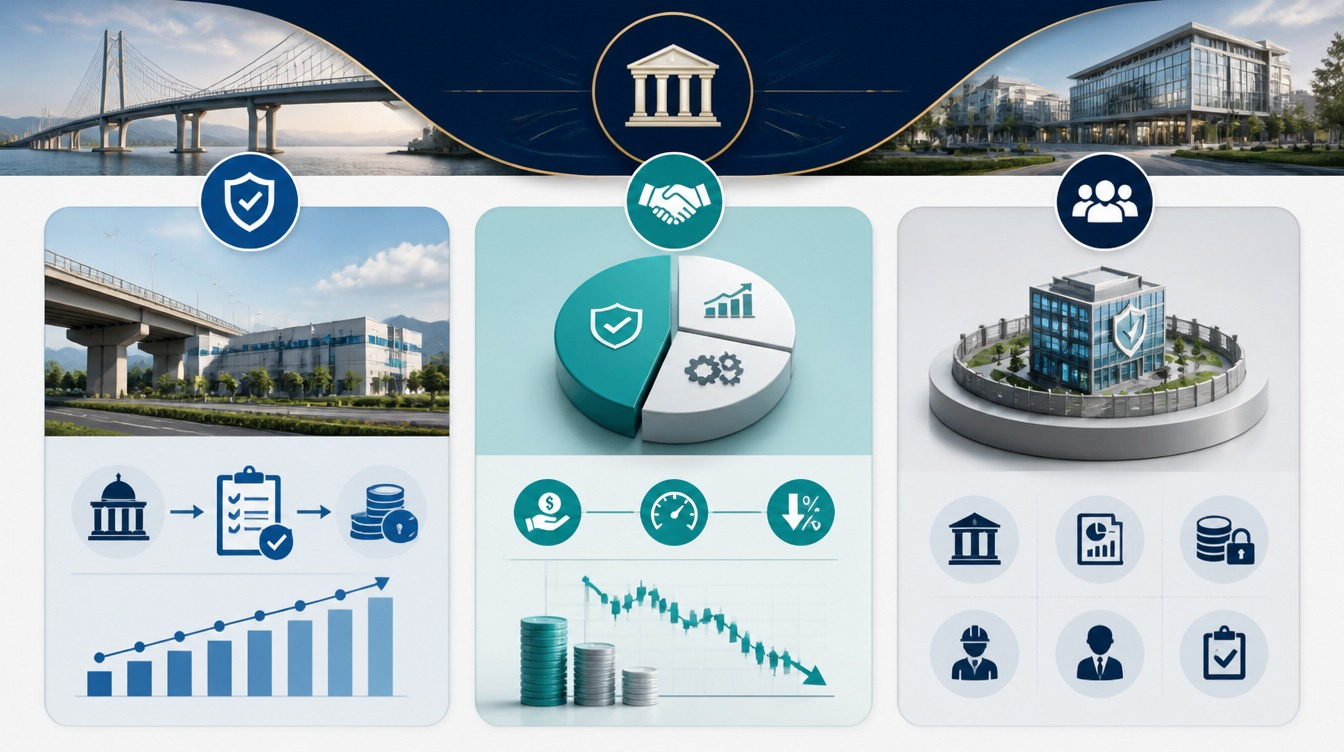
Deal Structures Attracting Institutional Capital
Availability-Payment Bonds
Availability-payment structures are increasingly popular among pension funds and insurers because they reduce demand risk. Under this model, government entities compensate project operators based on infrastructure availability and performance rather than user demand.
This creates more predictable cash flows and improves investor confidence.
Hybrid Revenue Models
Take-or-pay and payment-availability hybrid models combine revenue security with operational incentives. These structures often produce stronger credit profiles and can support lower financing costs.
Ring-Fenced Project Companies
Investors favor structures with:
- Independent governance
- Transparent reporting
- Segregated project accounts
- Technical oversight mechanisms
Independent technical advisors and performance verification frameworks further improve market confidence.
Asset-Backed Sukuk Structures
Infrastructure sukuk using lease-back or tangible asset-transfer structures provides additional security for investors while maintaining Sharia compliance. These structures continue gaining traction across Asia, the Middle East, and Africa.
Market Trends and Industry Developments
Institutional appetite for infrastructure debt continues to grow, especially in emerging markets where infrastructure demand remains high.
Key market developments include the following:
- Expansion of local-currency bond markets
- Greater multilateral involvement
- Improved regulatory frameworks
- Standardized project documentation
- Increased ESG-focused infrastructure investment
Credit-enhancement programs supported by development finance institutions have also helped improve project ratings and reduce borrowing costs for issuers.
As regulatory frameworks mature, domestic pension funds and insurance companies are increasing allocations to long-dated infrastructure debt instruments.
Benefits of Infrastructure Bonds and Sukuk
Long-Term Cash Flow Stability
Infrastructure projects often generate predictable revenue over long concession periods, making them suitable for liability-driven investment strategies.
Higher Yield Opportunities
Compared with many sovereign fixed-income products, infrastructure debt can offer enhanced returns while maintaining relatively stable income characteristics.
ESG and Sustainable Investment Alignment
Renewable energy, transportation, water, and social infrastructure projects often qualify under sustainability frameworks, helping issuers access ESG-focused capital pools.
Development of Local Capital Markets
Successful infrastructure bond programs strengthen domestic financial markets and increase long-term institutional participation in emerging economies.
Key Challenges
Credit Rating Constraints
Many infrastructure projects in emerging markets struggle to achieve investment-grade ratings without external support. This limits participation from conservative institutional investors.
Regulatory and Legal Complexity
Cross-border legal frameworks, tax treatment, procurement standards, and Sharia compliance requirements can increase transaction complexity and execution timelines.
Foreign Exchange Risk
Currency volatility remains a major concern for international investors, particularly when project revenues are denominated in local currency while financing obligations are foreign-currency-based.
Limited Secondary Market Liquidity
Infrastructure debt markets in many emerging economies remain relatively illiquid, which can discourage institutional participation.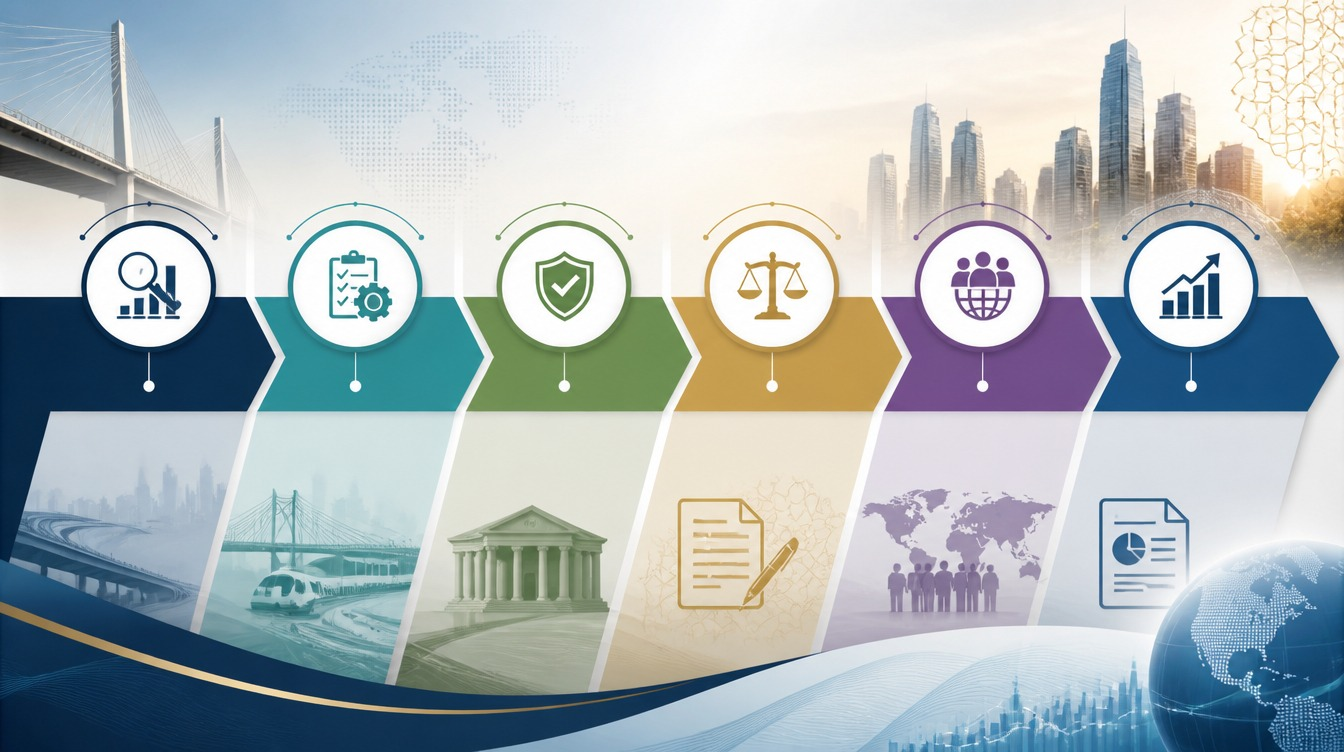
Step-by-Step Guide to Structuring an Institutional-Ready Infrastructure Bond or Sukuk
1. Conduct a market assessment.
Identify target investors, preferred currencies, expected tenor, and risk appetite before structuring the issuance.
2. Select the Appropriate Financing Structure
Choose between:
- Availability of payment bonds
- Revenue-backed project bonds
- Ijarah sukuk
- Murabaha sukuk
- Hybrid financing structures
The choice should align with project cash-flow predictability and investor expectations.
3. Build Credit Enhancement Into the Structure
Engage with:
- Multilateral development banks
- Export credit agencies
- Sovereign guarantors
- Insurance providers
Strong credit enhancement can significantly improve marketability.
4. Optimize Legal and Tax Structures
Ensure alignment between:
- Regulatory requirements
- Tax treatment
- Cross-border legal enforceability
- Sharia certification standards
This broadens the potential investor base.
5. Execute Investor Outreach
Investor roadshows should emphasize:
- Cash-flow stability
- ESG credentials
- Risk mitigation measures
- Governance standards
- Credit enhancement support
6. Support Secondary Market Liquidity
Transparent reporting, ongoing disclosures, and active servicing arrangements improve investor confidence after issuance.
Example: Availability-Payment Infrastructure Bond
Consider a hypothetical 20-year toll-road project financed through an availability-payment bond structure.
The transaction includes:
- Availability payments from a regional government
- A debt-service reserve account
- Partial multilateral guarantees
- Local-currency debt tranches
- Independent technical monitoring
This combination reduces demand risk, limits currency exposure, and broadens participation from domestic and international institutional investors.
Practical Tips for Issuers and Investors
For Issuers
- Standardize documentation early
- Improve disclosure quality
- Align procurement with investor expectations
- Engage credit-enhancement providers during initial planning
- Develop transparent reporting frameworks
For Investors
- Conduct integrated legal, engineering, and macroeconomic due diligence
- Evaluate cash-flow resilience carefully
- Require independent technical oversight
- Review termination and step-in rights
- Assess sovereign and currency exposure comprehensively
Conclusion
Infrastructure bonds and infrastructure sukuk are rapidly evolving into critical financing instruments for emerging markets seeking sustainable economic growth. As governments face increasing fiscal pressure and infrastructure demand continues to rise, institutional capital will play a central role in bridging the funding gap.
Well-structured project bonds supported by credit enhancement, transparent governance, and predictable revenue mechanisms can attract long-term investors such as pension funds, insurers, and sovereign wealth funds. At the same time, infrastructure sukuk is expanding access to Sharia-compliant capital while strengthening regional capital markets across Asia, Africa, and the Middle East.
At GBM, we believe the future of infrastructure financing depends on creating investment structures that balance risk management, regulatory alignment, and investor confidence. By combining financial advisory expertise, market intelligence, and institutional structuring capabilities, GBM helps clients design infrastructure financing solutions that are scalable, bankable, and globally competitive.
How GBM can help
Emerging markets cannot close their infrastructure gap through public funding alone. The next phase of infrastructure growth will depend on mobilizing long-term institutional capital through structured, investment-ready financing solutions.
GBM helps governments, infrastructure developers, and financial institutions transform complex infrastructure projects into bankable investment opportunities that attract pension funds, insurers, sovereign wealth funds, and global asset managers.
From infrastructure bonds and project finance structures to Sharia-compliant infrastructure sukuk, GBM delivers strategic advisory solutions designed to improve investor confidence, strengthen credit profiles, and accelerate capital mobilization.