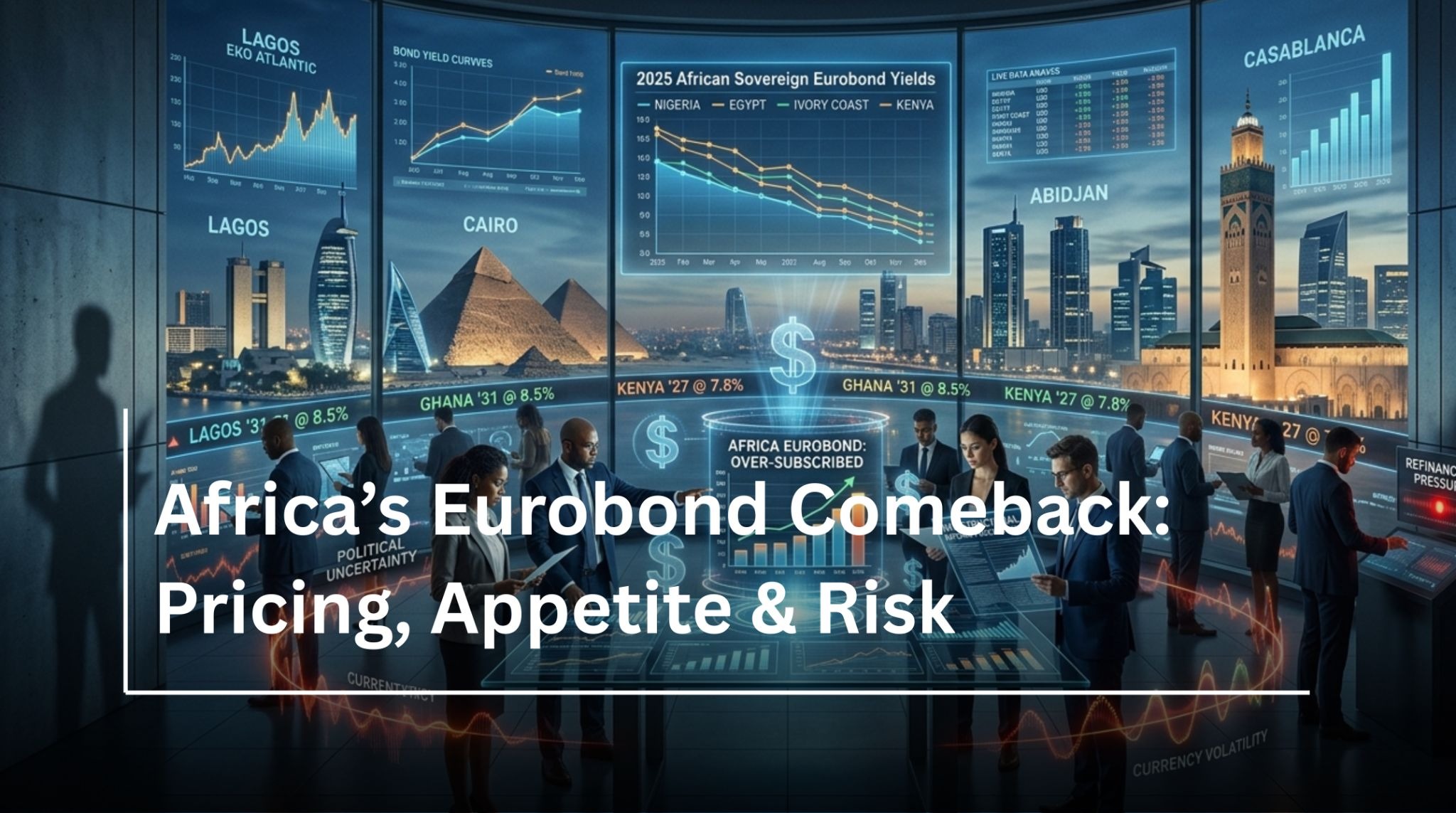
.png)

Structural shift toward pan-African capital markets integration
There is a growing and consistent push toward increasing intra-African investment flows, supported by regional financial institutions and policy frameworks. Across discussions, stakeholders emphasised the need to mobilise African institutional capital - including pension funds, insurers, and DFIs - to finance African infrastructure and corporates.
This reflects a broader shift toward building a more self-sustaining African financial architecture focused on deploying local capital into real economy assets.
The Africa–Middle East corridor is becoming a major capital axis
Middle East participation in African infrastructure, energy, logistics, and food systems continues to accelerate, particularly from the UAE and broader Gulf region.
This is being reinforced by the development of the Africa–Middle East corridor, which is emerging as a key strategic bridge for capital allocation, trade, and long-term investment flows between the two regions.
The region is increasingly acting as a strategic structuring and liquidity hub for African investment, with sovereign-linked financing, cross-border partnerships, and regional banking relationships playing an increasingly important role in facilitating USD and EUR funding flows into African markets.
Bankability and project preparation remain the key bottleneck
Across infrastructure, energy, and renewables, the dominant constraint is not capital availability, but deal readiness.
Recurring challenges include:
• Weak feasibility studies
• Insufficient ESG and IFC-equivalent standards
• Legal and governance structuring gaps
• Limited pipeline preparation for institutional participation
There is significant demand for blended finance structures, guarantees, first-loss capital, and credit enhancement mechanisms capable of unlocking larger pools of senior institutional capital.
Risk perception continues to distort capital allocation
International investors continue to apply elevated risk premiums to African assets, often disconnected from underlying market fundamentals.
This contributes to:
• Under-allocation of international capital
• Smaller ticket sizes from commercial lenders
• Continued dependence on DFIs and multilateral anchors
Many participants highlighted the need for stronger market transparency, improved data quality, and more sophisticated risk-sharing structures to close this perception gap.
Structured finance is replacing traditional fundraising models
Market participants are increasingly prioritising syndications, club deals, blended finance vehicles, and structured instruments over traditional fundraising approaches.
There is also continued preference for USD and EUR-denominated financing due to FX volatility and repatriation concerns, despite gradual growth in local currency lending capacity.
Risk mitigation tools - including sovereign guarantees, political risk insurance, and credit wraps - are becoming increasingly central to transaction execution.
Institutional capital is entering more selectively
African pension funds and insurers are gradually increasing allocations toward infrastructure and private markets, but capital deployment remains highly selective.
Investors are prioritising:
• Large-scale, investment-grade infrastructure platforms
• Aggregated pipelines rather than single-project exposure
• De-risked structures with strong governance frameworks
This reflects a broader shift toward platform-based investing and scalable capital deployment models.
Data transparency remains a critical structural challenge
One of the most frequently cited barriers to investment growth is the lack of reliable sovereign, corporate, and financial market data.
In response, the market is seeing increasing development of:
• Regional credit bureaus and rating agencies
• Standardised disclosure frameworks
• Enhanced market intelligence and reporting platforms
Improved information infrastructure is increasingly viewed as essential to lowering perceived risk and attracting institutional capital.
Regional investment hotspots
Several markets consistently emerged as priority investment destinations across discussions:
• East Africa: Kenya, Rwanda, Uganda, Tanzania
• West Africa: Senegal, Benin, Côte d’Ivoire, Nigeria
• Southern Africa: Botswana, South Africa
• Angola as an emerging infrastructure financing market
At the same time, the UAE continues to strengthen its role as a key structuring and capital hub for African deployment strategies.
Overall takeaway
The dominant market narrative is a transition from capital scarcity to structuring scarcity.
Africa is seeing growing pools of both global and domestic capital seeking exposure to infrastructure and real economy opportunities. However, the primary constraint is increasingly bankability, risk structuring, and information quality - rather than fundraising capacity itself.
This growing focus on market infrastructure and capital formation is also reflected in initiatives such as the Africa Financial Markets Forum in Kigali, Rwanda, which supports the development of African capital markets and investment flows across the continent. The most scalable opportunities are likely to emerge at the intersection of blended finance, credit enhancement, and cross-regional capital partnerships linking Africa, the Middle East, and global institutional investors.
This document reflects the views and observations of Global Banking & Markets based on market discussions and is provided for general information purposes only. It does not constitute investment advice.

We are the world leader in global markets-focused financing events in emerging markets. We bring complex markets together in one place at one time, facilitate informal networking & organise meetings which accelerate deal-flow. Connecting you with business partners and counterparties is at the heart of everything we do.