.png)

Table of Contents
For more than seven decades, the US dollar has been the backbone of the global financial system. It dominates international trade, cross-border lending, foreign exchange reserves, and sovereign debt issuance. For emerging markets (EMs), borrowing in dollars has long been both an opportunity and a source of vulnerability.
Today, however, the global monetary landscape is beginning to shift.
Growing geopolitical fragmentation, expanding BRICS cooperation, bilateral local-currency trade agreements, and efforts to reduce dependence on the dollar are accelerating discussions around a more multipolar currency system. While the US dollar remains the world's primary reserve currency, policymakers and market participants are increasingly preparing for a future where multiple currencies share global influence rather than one currency dominating international finance.
For emerging market issuers, this transition presents both opportunities and challenges. It could broaden funding options, reduce foreign exchange risk in some cases, and reshape investor demand but it also introduces greater complexity into capital markets.
Why the Dollar Became the Global Standard
The dominance of the US dollar did not happen overnight.
Following the Bretton Woods system and decades of deep, liquid US capital markets, the dollar became the preferred currency for
- International trade settlement
- Central bank reserves
- Commodity pricing
- Sovereign borrowing
- Cross-border investment
Even after the Bretton Woods framework ended, the dollar retained its leadership because investors trusted the liquidity, stability, and transparency of US financial markets.
Today, a significant share of global trade and international debt continues to be denominated in US dollars, making it the default currency for many emerging market governments and corporations.
Why Countries Are Looking Beyond the Dollar
The discussion around reducing dollar dependence is no longer theoretical.
Several structural forces are encouraging governments to diversify.
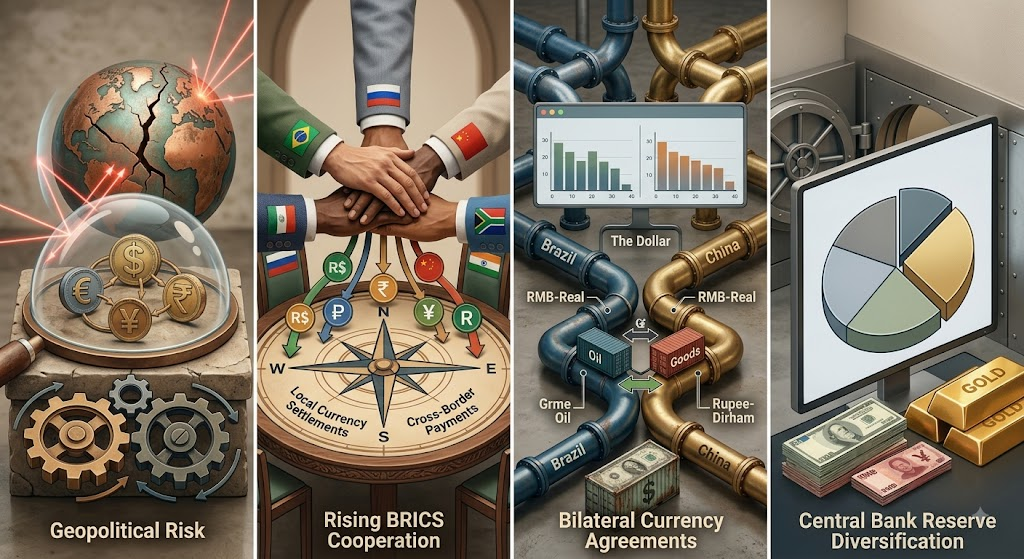
1. Geopolitical Risk
Economic sanctions and financial restrictions have highlighted the risks of relying heavily on a single global currency.
Many countries now view payment diversification as part of broader economic resilience rather than purely a political decision.
2. Rising BRICS Cooperation
BRICS nations have increased discussions around:
- Local currency settlements
- Cross-border payment systems
- Trade financing outside the dollar
- Greater financial cooperation between member economies
Although there is no immediate replacement for the dollar, these initiatives indicate growing interest in reducing reliance on a single reserve currency.
3. Bilateral Currency Agreements
Countries are increasingly signing agreements that allow imports and exports to be settled in domestic currencies.
Examples include agreements involving China, India, Brazil, the UAE, and several ASEAN economies.
These arrangements reduce transaction costs while lowering exposure to dollar exchange rate fluctuations.
4. Central Bank Reserve Diversification
Many central banks have gradually diversified reserve holdings by increasing allocations to:
- Gold
- Euro
- Chinese Renminbi (RMB)
- Other reserve assets
Rather than abandoning the dollar, reserve managers are increasingly adopting more diversified portfolios.
Does This Mean Dollar Dominance Is Ending?
Not necessarily.
The US dollar continues to benefit from several structural advantages:
- The world's deepest government bond market
- Highly liquid financial markets
- Strong institutional credibility
- Broad investor confidence
- Established global payment infrastructure
Replacing these advantages would take decades rather than years.
Instead of a rapid transition, the more realistic outcome is the gradual emergence of a multipolar currency system, where several major currencies coexist alongside the dollar.
This would make global finance more diversified rather than replacing one dominant currency with another.
What a Multipolar Currency World Means for Emerging Market Issuers
This transition could significantly reshape funding strategies for sovereigns and corporations.
Greater Funding Flexibility
Historically, many EM borrowers relied heavily on US-dollar debt because international investors preferred dollar-denominated securities.
As regional capital markets deepen, issuers may gain greater flexibility to issue debt in
- Local currencies
- Euro
- Renminbi
- Regional currencies
A broader funding base can improve financial resilience by reducing dependence on a single market.
Reduced Currency Mismatch
One of the biggest challenges facing emerging markets has been currency mismatch.
Many governments generate tax revenues in local currency while servicing debt in US dollars.
When local currencies weaken, debt servicing costs rise sharply.
Issuing more debt in domestic or regional currencies can reduce this mismatch and improve fiscal stability.
Insight
Countries with stronger local bond markets may become less vulnerable to sudden dollar appreciation, although investor demand and domestic market depth remain critical factors.
More Diverse Investor Base
As financing expands beyond dollar markets, issuers may attract investors from:
- Asia
- Middle East
- Europe
- Domestic pension funds
- Regional institutional investors
A more diversified investor base can reduce refinancing concentration risk.
Higher Importance of Local Capital Markets
A multipolar currency environment places greater emphasis on developing domestic financial markets.
Governments that strengthen:
- Local bond markets
- Pension systems
- Regulatory transparency
- Market liquidity
are likely to gain greater financing independence over time.
The World Bank has consistently highlighted local capital market development as an important driver of long-term financial resilience.

New Challenges Emerging Market Issuers Must Manage
The transition also introduces new risks.
Increased Market Complexity
Managing funding across multiple currencies requires more sophisticated treasury operations.
Issuers must monitor:
- Multiple interest-rate cycles
- Currency volatility
- Hedging costs
- Liquidity differences
Financing decisions become more complex than simply comparing dollar borrowing costs.
Liquidity Differences Across Markets
The US Treasury market remains the world's most liquid.
Alternative currency markets often have:
- Smaller investor pools
- Lower trading volumes
- Higher issuance costs
- Limited secondary market liquidity
This can affect pricing and execution.
Greater Exchange Rate Volatility
Holding liabilities across several currencies introduces new portfolio management challenges.
Instead of managing exposure to only the dollar, issuers may need strategies covering multiple currency risks simultaneously.
Regulatory Differences
Cross-border issuance increasingly involves navigating different legal frameworks, disclosure standards, and settlement systems.
Institutional capacity becomes even more important.
How Investors Are Responding
Investors are also adapting to this changing environment.
Many global asset managers now seek the following:
- Geographic diversification
- Currency diversification
- Higher-yielding emerging market assets
- Strong local-currency debt opportunities
Recent issuance trends suggest growing investor appetite for non-dollar debt alongside continued demand for traditional dollar bonds.
However, investors remain selective.
Markets continue to reward issuers demonstrating:
- Sound fiscal policy
- Transparent governance
- Credible monetary policy
- Sustainable debt management
In a multipolar currency system, institutional credibility may matter even more than currency choice.
Strategic Considerations for Emerging Market Policymakers
Governments preparing for a more diversified global monetary system should focus on several long-term priorities:
Strengthen domestic bond markets
Deep local capital markets reduce dependence on external financing.
Improve debt transparency
Clear reporting increases investor confidence and supports pricing efficiency.
Diversify funding sources
Maintaining access to multiple currencies and investor groups enhances resilience during market stress.
Enhance risk management
Active currency and interest rate risk management becomes increasingly important as funding options expand.
Maintain macroeconomic credibility
Stable inflation, predictable fiscal policy, and independent institutions remain essential regardless of the currency used for issuance.
Looking Ahead
The conversation around de-dollarization often generates headlines, but the reality is more nuanced.
The US dollar is unlikely to lose its central role in global finance in the near future. However, the steady expansion of regional payment systems, bilateral currency agreements, and local-currency financing suggests the global financial architecture is becoming more diversified.
For emerging market issuers, success will depend less on abandoning the dollar and more on building flexible funding strategies that combine multiple financing channels, resilient domestic capital markets, and disciplined macroeconomic policies.
In a world where capital is increasingly global but risks are more fragmented, adaptability may become the defining competitive advantage.
Conclusion
The evolution toward a multipolar currency system represents one of the most significant structural developments in global finance. While the US dollar remains indispensable, emerging markets are gradually expanding their financing options through local-currency issuance, regional partnerships, and diversified investor engagement.
Rather than signaling the end of dollar dominance, these trends point to a more balanced and flexible international monetary environment. For sovereigns, corporates, investors, and policymakers, understanding these dynamics will be critical to managing funding costs, mitigating currency risks, and identifying opportunities across evolving emerging market debt landscapes.
Why This Matters to Global Banking & Markets (GB&M)
As financing ecosystems evolve and emerging market capital flows become increasingly complex, market participants need timely insights and trusted connections to navigate change.
Global Banking & Markets (GB&M) brings together sovereign issuers, investors, development finance institutions, banks, regulators, and corporate leaders across emerging markets to discuss the trends shaping debt capital markets, cross-border financing, and macroeconomic risk. Through its industry-leading conferences and networking platforms, GB&M helps decision-makers exchange ideas, build relationships, and stay ahead of developments influencing global capital formation and emerging market finance.