.png)
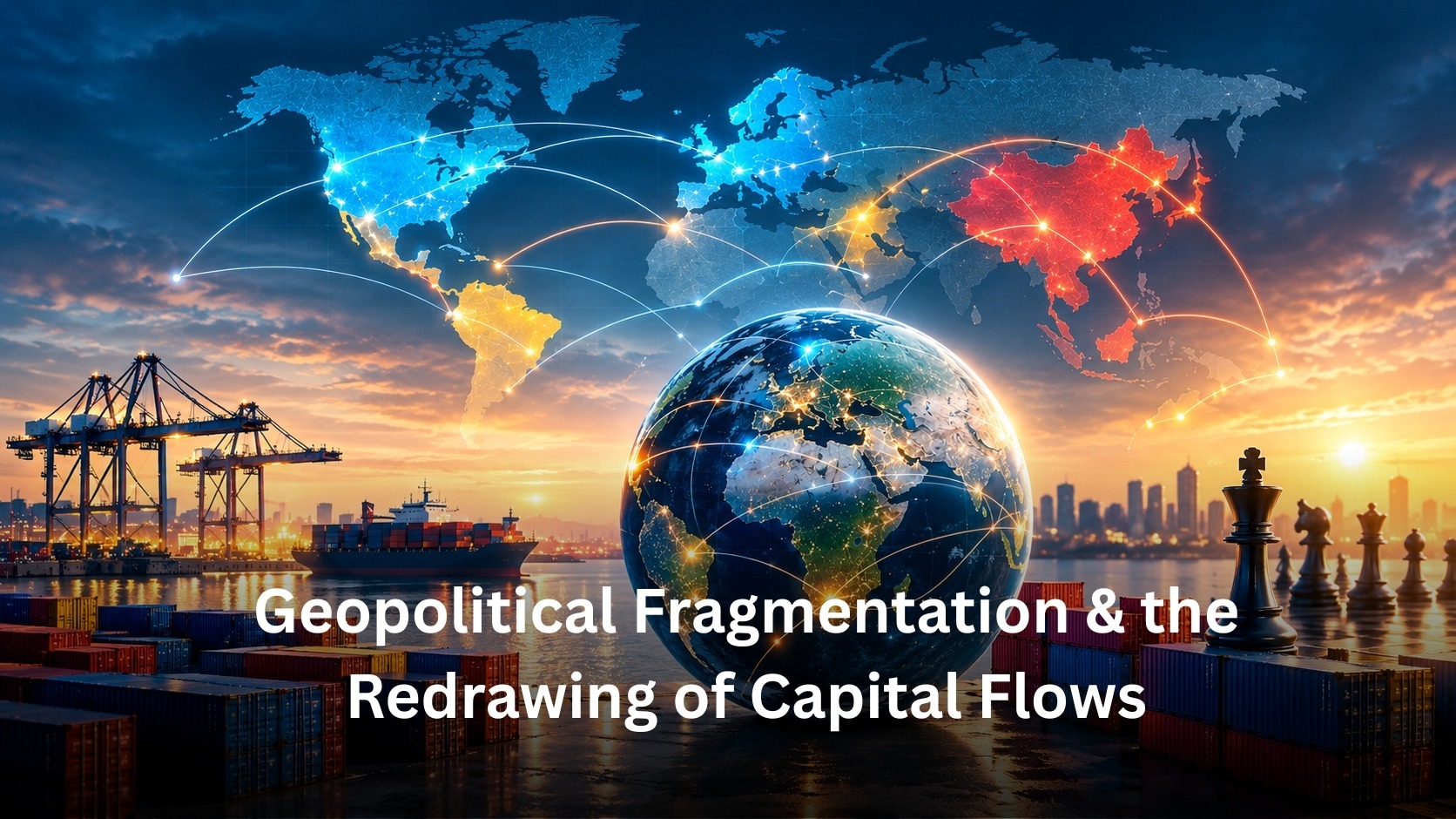
Table of Contents
How friend-shoring, sanctions and supply-chain restructuring are creating a new investment geography
For decades, global capital largely followed a familiar map. Investment flowed toward markets offering scale, competitive costs, strong growth prospects and access to global supply chains. Multinational companies built production networks across borders, investors diversified internationally, and financial institutions connected businesses and economies through increasingly integrated capital markets.
That model is changing.
Growing geopolitical tensions, trade restrictions, sanctions, national-security considerations and supply-chain vulnerabilities are encouraging governments and businesses to reconsider where they source, manufacture and invest. The result is a gradual fragmentation of the global economy, with capital increasingly influenced not only by economic efficiency, but also by strategic alignment, resilience and geopolitical risk.
This is creating a new investment geography.

From Globalisation to Strategic Alignment
The traditional globalisation model prioritised efficiency. Companies often located production where labour, infrastructure, resources and operating costs offered the greatest advantages.
Today, resilience is becoming equally important.
The rise of friend-shoring reflects this shift. Rather than concentrating critical production or sourcing in locations selected purely on cost, businesses are increasingly looking toward countries considered strategically aligned or politically reliable.
This trend is particularly visible across sectors such as semiconductors, energy, critical minerals, pharmaceuticals, defence and advanced manufacturing.
For investors, the implications extend beyond individual companies. New factories, logistics networks, energy infrastructure and technology ecosystems require significant amounts of capital, creating opportunities across both public and private markets.
Capital is therefore beginning to follow strategic supply chains.

Sanctions Are Changing the Risk Equation
Sanctions have also become an increasingly important factor in cross-border investment decisions.
For financial institutions and investors, geopolitical exposure can affect everything from market access and transaction structures to currency convertibility, counterparty risk and the ability to repatriate capital.
This means geopolitical risk is no longer simply an external consideration for investment committees. It is increasingly becoming part of the fundamental assessment of a transaction.
Businesses operating across multiple jurisdictions may need to reconsider their funding sources, treasury structures and supply-chain dependencies. Investors, meanwhile, may place greater emphasis on jurisdictional diversification and the resilience of portfolio companies.
The result is a more complex capital environment where risk-adjusted returns increasingly incorporate geopolitical considerations.

Supply Chains Are Creating New Investment Corridors
Supply-chain restructuring could be one of the most significant channels through which geopolitical fragmentation affects capital flows.
Companies are diversifying manufacturing footprints, developing alternative suppliers and investing in regional production capabilities. Countries positioned to benefit from these shifts can attract new foreign direct investment, infrastructure spending, and industrial capital.
Mexico, for example, has benefited from its proximity to the US and its role in North American manufacturing. India is seeking to strengthen its position in electronics, pharmaceuticals, and advanced manufacturing. Southeast Asian economies are attracting investment as companies diversify production networks across Asia.
Meanwhile, countries rich in critical minerals and energy resources are gaining strategic importance as economies invest in the technologies required for electrification, digitalisation and the energy transition.
This creates an emerging investment map where geographic proximity, resource security, and political alignment can influence capital allocation almost as much as traditional economic fundamentals.
The Rise of Regional Capital Markets
As global supply chains become more regional, capital markets could follow a similar trajectory.
Companies may increasingly seek funding closer to their strategic markets, while regional investors gain greater importance in financing infrastructure and corporate expansion.
This could accelerate the development of local bond markets, private credit, infrastructure funds and other alternative financing channels.
For emerging markets, this presents both an opportunity and a challenge.
Countries able to provide stable institutions, investable markets, reliable infrastructure and predictable regulatory environments may attract a greater share of global capital. Those perceived as exposed to significant geopolitical or policy risks may face higher financing costs or reduced access to international investors.
The competitive landscape for attracting capital is therefore changing.
What Does This Mean for Investors?
For investors, geopolitical fragmentation creates a more complicated opportunity set.
Diversification can no longer be considered purely through the lens of geography or asset class. Investors increasingly need to understand how political relationships, trade corridors, sanctions regimes and strategic dependencies can influence individual investments.
At the same time, fragmentation creates opportunities.
Infrastructure investment, supply-chain relocation, renewable energy, data centres, logistics, manufacturing capacity, and critical minerals could all benefit from the redirection of capital.
Private markets may be particularly relevant because many of these investments require patient, long-term capital and involve projects that cannot easily be financed through traditional public-market structures.
The opportunity lies in identifying where geopolitical priorities intersect with economic fundamentals.
Corporates Face a New Capital Strategy
For corporates, the changing environment requires more than simply relocating production.
Companies need to evaluate how geopolitical developments affect their financing structures, suppliers, customers and investment plans.
A business may find that raising capital in one market provides cost advantages but increases geopolitical exposure. Another may choose a more expensive financing route because it offers greater stability or access to a strategically important investor base.
Treasury and capital-market decisions are therefore becoming increasingly connected to corporate strategy.
This could lead to greater demand for tailored financing solutions, cross-border advisory and risk-management strategies as companies navigate an increasingly fragmented financial environment.
The New Geography of Capital
The most important shift may be that capital is not necessarily becoming less global. Instead, the criteria determining where capital flows are becoming more complex.
Economic growth remains important. So do valuations, interest rates, productivity and market depth.
But alongside these factors, investors and corporates are increasingly considering:
- Geopolitical alignment
- Supply-chain resilience
- Sanctions exposure
- Critical-resource security
- Regulatory stability
- Infrastructure capacity
- Market access
- Currency and funding risks
- Strategic importance of specific industries
Together, these factors are reshaping the geography of investment.
The next phase of global capital allocation may therefore be defined not by complete deglobalisation, but by selective integration: deeper economic relationships between aligned markets, more diversified supply chains and increasingly strategic deployment of capital.
For financial institutions, understanding this transition will be critical. The winners may be those capable of connecting capital with opportunities while navigating the increasingly complex intersection of markets, policy and geopolitics.
GB&M Perspective: Navigating the New Investment Geography
For Global Banking & Markets, geopolitical fragmentation represents more than a challenge. It creates a new landscape for corporate finance, investment and capital-market activity.
As businesses reassess supply chains, expand into strategically important markets, and seek more resilient funding structures, they require financial partners capable of understanding both market dynamics and geopolitical complexity.
GBM helps corporates, investors, and institutions evaluate emerging investment corridors, access international and regional capital markets, structure financing solutions, and manage the risks associated with a changing global economic order.
The opportunity is not simply to follow where capital is moving.
It is to understand why it is moving, where it is likely to move next, and how businesses and investors can position themselves accordingly.