.png)
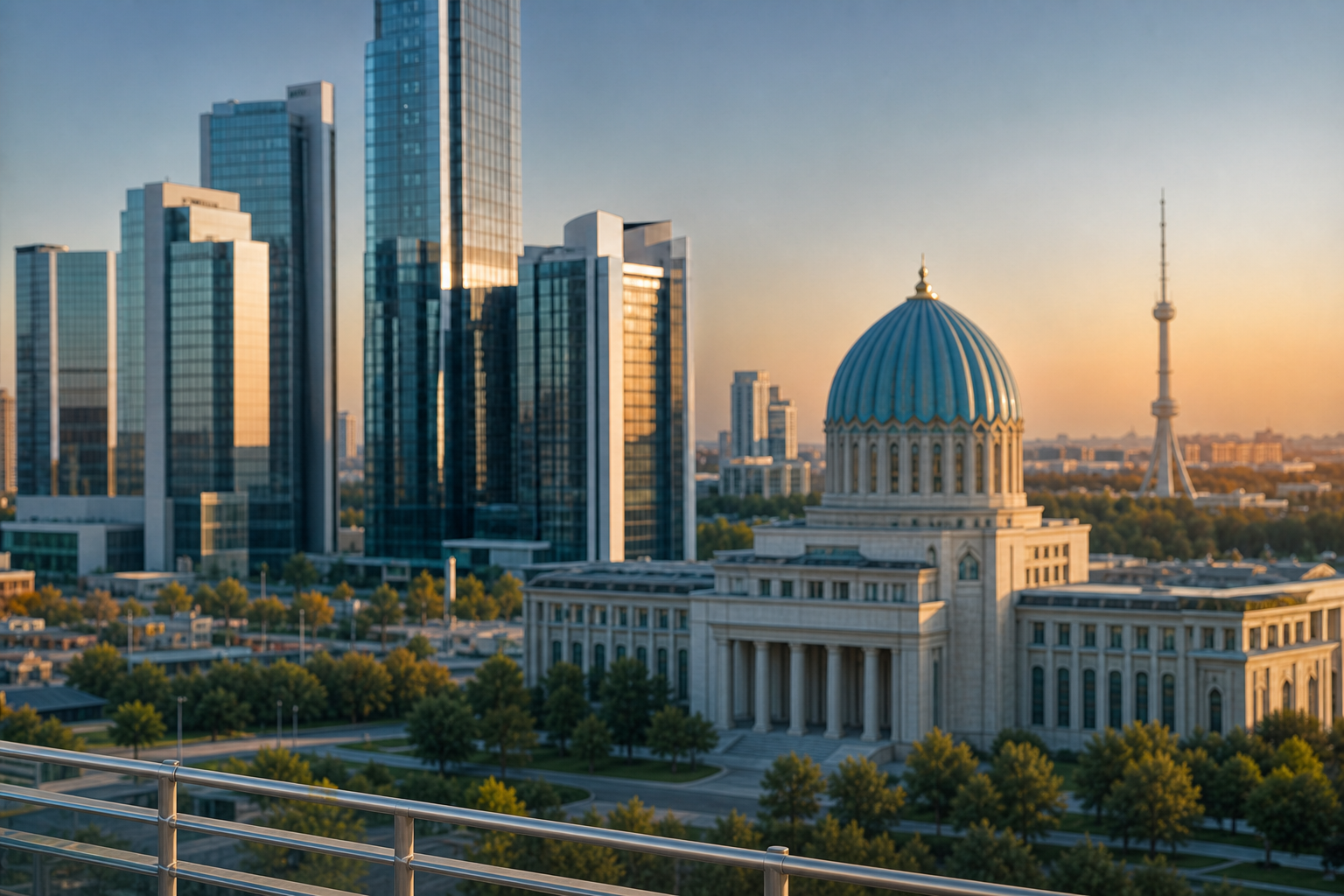
Insights from the Global Banking & Markets Uzbekistan Capital Markets Boardroom in Tashkent
Uzbekistan’s emergence as an increasingly significant capital-markets issuer has been one of the clearest financial-market developments in Central Asia over recent years. The country has progressed from an occasional sovereign borrower to a market supporting international issuance by banks, state-owned enterprises and corporates, alongside a growing range of local-currency and equity transactions.
That progress was evident at the Global Banking & Markets Uzbekistan Capital Markets Boardroom in Tashkent, which brought together more than 40 government officials, leading global investors, business leaders, and treasury and funding professionals from many of the country’s largest banks and companies.
The discussion suggested that Uzbekistan has moved beyond the first stage of market development. The central question is no longer whether Uzbek institutions can access international capital. A growing number have demonstrated that they can.
The questions now are how they can access markets more consistently, extend maturities, diversify their currencies and investor bases, improve secondary liquidity, and build a domestic capital market capable of complementing international issuance.
The meeting also highlighted a widening of the capital-markets discussion. Debt issuance remains central, but it is increasingly being considered alongside bank privatisation, international equity listings, domestic institutional investment and the transformation of major state-owned companies.
1. Uzbekistan is no longer an occasional capital-markets story
A recurring theme was that Uzbekistan is becoming a recognised component of the emerging and frontier-market investment universe rather than an occasional or peripheral borrower.
Investors pointed to strong economic growth, favourable demographics, a diversified economy and an increasingly important position on the trade and infrastructure corridors connecting Asia and Europe. These structural attractions have been reinforced by reforms to the exchange-rate regime, monetary policy, financial reporting, bank ownership and market infrastructure.
Uzbekistan’s capital-markets activity has also broadened materially. The sovereign has established international benchmarks in dollars, euros and soum. Banks have issued senior debt, dual-currency transactions and capital instruments. State-owned enterprises and major corporates have also entered the market.
This widening issuer base matters. Repeat transactions give international accounts more ways to express a view on Uzbekistan and allow investors to distinguish between the sovereign, banks, industrial companies and infrastructure credits.
The next stage is therefore less about proving that the market exists and more about building continuity. Investors want to see a reliable pipeline, a range of maturities and more opportunities to trade between different Uzbek credits.
2. Macroeconomic credibility is becoming a funding advantage
Investor confidence begins well before an issuer presents its own financial statements or funding plans. It starts with confidence in the sovereign, the monetary framework and the institutions supporting the wider economy.
Participants highlighted Uzbekistan’s transition towards inflation targeting, greater exchange-rate flexibility, improving market transparency and the development of more reliable money-market and government-bond benchmarks.
The progress in bringing inflation down was welcomed, although it was recognised that monetary policy remains deliberately tight. High local interest and deposit rates continue to shape funding decisions and can make domestic bond issuance prohibitively expensive for some companies.
Nevertheless, the direction of travel matters. Falling inflation, greater currency stability and a more credible yield curve should gradually reduce local funding costs and make soum-denominated instruments more viable.
There was also discussion of the possibility of Uzbekistan moving towards an investment-grade sovereign rating over the medium term. This was not presented as guaranteed. But investors believed that a clearly communicated ambition, supported by sustained reform and institutional development, could itself improve market perception.
Investment grade would be important far beyond the sovereign. It would increase the universe of funds able to hold Uzbek risk, strengthen benchmarks for banks and companies, and potentially broaden access to euro-denominated and Islamic capital-market investors.
3. A longer sovereign curve would unlock more corporate issuance
International investors stressed the need for a deeper and more complete sovereign yield curve.
Corporate and bank bonds are usually assessed and priced as a spread over the sovereign. Without liquid sovereign benchmarks at longer maturities, private and state-owned issuers can struggle to establish fair pricing or issue beyond five or seven years.
The discussion therefore distinguished between sovereign borrowing for financing purposes and sovereign issuance for market-development purposes.
Uzbekistan may not need to maximise external sovereign borrowing, particularly if it can mobilise more domestic capital. But it does need credible and liquid reference points across the curve. Maintaining outstanding benchmarks and extending beyond current maturities would help companies and banks issue longer-dated debt.
The recent internationally placed soum sovereign transaction demonstrated substantial demand for local-currency exposure. But a single successful deal does not create a fully functioning market. Investors will look for repeat issuance, secondary liquidity, reliable prices and an efficient means of entering and exiting positions.
A well-maintained sovereign curve would therefore serve as market infrastructure, not merely as a funding tool.
4. Investors like the story - but they are becoming more demanding
One of the clearest findings from the Boardroom was that international understanding of Uzbekistan has improved sharply.
Sovereign investor education, repeat transactions and the growing number of bank and corporate issues mean that many investors now arrive at meetings with a detailed view of the macroeconomic story. The questions are becoming more issuer-specific and more demanding.
Investors want to understand strategy, governance, capital, asset quality, cash flow, dividend policy, state relationships and the effect of privatisation or ownership changes. They compare banks with other Uzbek institutions and with peers elsewhere in Central Asia.
This means the country story can open the door, but it cannot compensate for weak company-level disclosure.
Recent transactions also provided concrete evidence of how the investor base is changing.
A pioneering Uzbek bank capital transaction attracted indications from 132 investors and generated an order book more than five times the targeted size. The issuer had initially questioned whether the market would support such an unfamiliar instrument, which lacked a direct benchmark in Uzbekistan or elsewhere in Central Asia.
Instead, demand extended beyond the traditional US, UK, German and Swiss investor base. Accounts from Central and Eastern Europe participated, as did institutional investors in the Middle East. There was also engagement from China, although Chinese demand was described as still more focused on investment-grade opportunities.
Several larger accounts placed double-digit-million-dollar orders. The transaction demonstrated that investors were prepared to move beyond plain-vanilla senior bonds when the structure, regulatory treatment and credit story were adequately explained.
A separate recent $300 million bank transaction attracted 84 investors, with bonds ultimately allocated to 61 accounts. Approximately 24%–25% of the issue went to the US, around 23% to continental Europe and about 20% to the UK. The UAE and Asia each contributed a smaller but still relevant share.
The order book initially exceeded $1.2 billion and finished at approximately $1.06 billion despite a significant tightening in pricing. The fact that investors remained in the book after close to a percentage point of price compression was an important indication of genuine demand rather than purely price-sensitive orders.
The issuer met 34 investors through a combination of physical meetings in London and virtual calls. It credited earlier non-deal roadshows with helping to create the familiarity needed to execute successfully in a volatile market.
These examples show an investor base that is becoming broader geographically, more knowledgeable about Uzbekistan and more willing to assess individual credits on their own merits.
5. Preparing for a Eurobond takes longer than the roadshow
Recent issuers stressed that a bond transaction is not a one-week marketing exercise. It is the culmination of months of preparation.
Successful execution requires coordination across treasury, finance, risk, compliance, legal teams, senior management and the supervisory board. It also requires sustained engagement with regulators, auditors, lawyers, rating agencies and bookrunners.
For more complex instruments, the challenge is greater. The pioneering bank capital transaction required seven to eight months of work. Regulatory recognition of the instrument’s capital treatment was critical to investor confidence, as was the involvement of external auditors and international legal advisers.
Issuers also highlighted the value of the 144A format in reaching US institutional investors, although this involves more extensive disclosure and legal due diligence than a Reg S-only transaction.
Another repeated lesson was that the headline coupon is not the full price. Bank fees, legal expenses, ratings, documentation and other execution costs can add materially to the economics of a deal. Boards and management teams need to understand the all-in cost before approving a transaction.
Even relatively small improvements in structuring can create savings. One issuer described using provisions in an earlier bond’s terms to redeem it ahead of final maturity, reducing the overlap between the old and new transactions and saving a significant amount in interest expense.
6. Market access should be maintained, not used only in emergencies
One bank explained that it had enough liquidity to repay a maturing bond and could also have relied on support from its international parent. It nevertheless chose to return to the market.
The objective was to maintain the institution’s name, preserve an international benchmark and keep its relationship with investors active.
This illustrates a more mature approach to capital markets. A Eurobond is not simply a source of emergency liquidity. It can be part of an issuer’s long-term funding identity.
Institutions that come to market only when they urgently need money will have less flexibility over timing, structure and pricing. Those that maintain investor relationships, keep documentation current and preserve several funding options can act when market conditions are favourable.
The recent $300 million transaction provided a good example. The issuer did not face immediate liquidity pressure. It identified a relatively stable period in an otherwise volatile market, divided its team between virtual engagement and an accelerated London roadshow, and chose to price promptly rather than wait for a theoretically perfect window.
That flexibility was possible because much of the investor education had already taken place.
The value of non-deal roadshows was emphasised repeatedly. Investors prefer to understand a credit before a live transaction begins. Regular engagement allows an issuer to explain its strategy, answer difficult questions and build confidence without the pressure of an immediate order book.
7. The investor base is broadening beyond traditional EM funds
Traditional emerging-market funds remain central to Uzbekistan’s international debt market, but the base is becoming more diverse.
Recent issues have attracted US institutional accounts, UK and continental European asset managers, specialist frontier-market investors, bank treasuries, Middle Eastern institutions and some Asian participation.
The Middle East appears particularly relevant for financial-institution bonds and bank capital. One issuer specifically linked stronger regional participation to the inclusion of Middle Eastern banks in the underwriting group, which brought their own investor networks to the transaction.
Asia remains an important potential source of diversification. However, some Chinese and other Asian investors may remain more comfortable with investment-grade instruments or issuers already included in widely followed indices.
Index eligibility itself is an important factor. Dollar sovereign bonds can enter the principal emerging-market sovereign indices, while corporate Eurobonds may qualify for the relevant corporate indices. Inclusion makes it easier for benchmarked investors to establish positions.
Local-currency debt faces a higher threshold. International local-bond indices require sufficient size, accessibility and liquidity. Investors noted that even large global funds cannot justify opening a new currency position for a very small allocation. They require enough outstanding bonds and secondary liquidity to build and, when necessary, exit a meaningful position.
The conclusion was that attracting a buyer in one transaction is not the same as building a durable investor base. Issuers need an ongoing investor-relations programme providing consistent information before and after issuance.
8. Post-issuance communication matters as much as execution
The Boardroom repeatedly returned to the importance of what happens after a deal closes.
An issuer may execute successfully, but investor confidence can deteriorate quickly if financial reports are late, strategy changes are poorly explained or management becomes inaccessible.
Timely audited accounts, regular results calls, non-deal roadshows and clear explanations of ownership, governance or regulatory developments all support secondary performance and future issuance.
Post-deal communication is especially important in a relatively new market. Investors do not assess one Uzbek issuer in isolation. Problems at a prominent bank or company can affect perceptions of other credits and, in some cases, the country as a whole.
The same principle applies positively. Strong reporting, effective governance and good secondary performance create confidence that benefits the next issuer.
Uzbek institutions therefore have a collective interest in maintaining high standards. Each successful transaction strengthens the market; each poorly managed credit risks increasing the cost of capital for others.
9. Local markets have infrastructure—but not yet enough depth
The discussion on domestic capital markets exposed both progress and frustration.
Uzbekistan has introduced important elements of market infrastructure, including benchmark rates, improvements to settlement, a primary-dealer framework and wider access to government securities. Corporate bonds can already be purchased through local investment applications, and a growing number of smaller banks and companies have completed domestic deals.
Yet technical access has not produced a deep market. Secondary trading remains limited, price transparency is inconsistent and many retail investors are still more familiar with bank deposits than bonds.
Deposit rates have been particularly difficult for corporate bonds to compete with. When households can obtain relatively high returns through a simple and familiar deposit, companies may need to offer coupons that are uneconomic for most businesses.
Transaction and brokerage costs can further reduce the attractiveness of bonds. Even where securities are available through a mobile application, investors may lack user-friendly information about yield, duration, historical performance and credit risk.
Participants nevertheless believed the situation could change as inflation and deposit rates fall. Uzbekistan has a large and young population, rising incomes and substantial pools of capital outside formal investment products.
To turn that potential into an effective market, the Boardroom identified several priorities: better financial education, clearer information on yields and returns, lower transaction costs, stronger market-making, reliable prices on international and domestic trading screens, and cooperation between banks, regulators and the stock exchange.
10. Pension reform could transform the local market
The development of a competitive private pension system was identified as potentially the most important long-term reform for both debt and equity markets.
A funded pension system receives regular contributions that must be invested. In its early decades, inflows generally exceed distributions, creating a sustained pool of long-term domestic capital.
Young pension systems usually invest heavily in government and high-quality corporate fixed income. This could reduce the sovereign’s dependence on foreign investors, create consistent demand for corporate bonds and improve secondary liquidity.
Competition between pension managers would also matter. A single passive buyer may accumulate and hold bonds without generating trading activity. Multiple managers competing on performance would need to buy and sell, helping create a functioning secondary market.
Uzbekistan’s young population could give such a system an especially long accumulation period. The result would be a locally anchored investor base less vulnerable to changes in international risk appetite.
11. International and domestic issuance should complement each other
The Boardroom did not produce a simple answer to whether Uzbek issuers should borrow domestically or internationally.
International markets currently offer larger transaction sizes, broader investor diversification and, in many cases, lower nominal coupons. They also provide visibility and impose useful disciplines around governance and disclosure.
Domestic bonds can reduce currency mismatches, mobilise investors that understand local institutions, and make issuers less vulnerable to global volatility.
The appropriate choice depends on the issuer’s revenues, assets and funding needs. Dollar debt makes sense for businesses with dollar revenues or dollar assets. Soum funding is more appropriate for institutions whose activities are predominantly in local currency.
A low dollar coupon is not automatically cheap if proceeds must be converted into soum and hedging is unavailable or expensive. The further development of swaps and other risk-management instruments will therefore be important.
Over time, issuers are likely to combine international dollar bonds, internationally placed soum issuance, domestic corporate bonds and alternative structures. Euro issuance could become more viable if Uzbekistan moves towards investment grade. Sukuk may also offer access to additional pools of Middle Eastern and Asian capital.
12. Dual listings may be the strongest route for Uzbek equity issuers
A notable feature of the Boardroom was the connection between debt-market development and Uzbekistan’s emerging equity programme.
A recent dual listing of a portfolio of state-owned assets was presented as a landmark transaction that increased the country’s international visibility and created a possible route for future privatisations.
The process also demonstrated the amount of legal, regulatory and institutional work required to complete an international listing. Multiple laws and market rules had to be adapted, while the underlying companies needed stronger governance and clearer transformation plans.
For future Uzbek issuers, a dual listing may provide the most balanced solution.
An international listing offers access to deeper liquidity, a wider institutional base and potentially stronger valuation. A simultaneous Tashkent listing allows domestic investors to participate and supports the development of the local exchange.
London was seen as the natural venue for many traditional Uzbek emerging-market businesses because of its established investor base, depositary-receipt infrastructure and generally lower regulatory burden than the US.
The US may be appropriate for some large technology or high-growth companies seeking the deepest available equity pool. But companies need to consider their size, sector, target investors, compliance costs and the danger of being overlooked in a much larger market.
The broader lesson was that listing is not the destination. Companies must first improve governance, efficiency, profitability and investor communication. A public listing creates scrutiny as well as opportunity.
13. The next phase will be defined by execution
Uzbekistan has already shown that its sovereign, banks and major companies can raise international capital. Recent transactions have also shown that global investors will support well-prepared Uzbek deals even during volatile markets.
The next stage will be more demanding.
It requires repeat issuance rather than isolated deals; a deeper sovereign curve; continued progress towards investment grade; consistent investor relations; more reliable secondary prices; domestic institutional savings; and a credible pipeline of both debt and equity transactions.
There is no shortage of potential issuers. Banks are considering senior debt and capital instruments, while utilities, transport companies, industrial businesses and other state-owned enterprises need financing for investment, refinancing and transformation.
But the quality of the pipeline will matter more than its size. Investors are increasingly familiar with Uzbekistan and will differentiate closely between institutions.
The clearest conclusion from the Tashkent Boardroom was therefore that Uzbekistan has won access to the global capital markets. Its next challenge is to convert that access into a broad, liquid and durable capital-markets ecosystem.
This document reflects the views and observations of Global Banking & Markets based on market discussions and is provided for general information purposes only. It does not constitute investment advice.
We are the world leader in global markets-focused financing events in emerging markets. We bring complex markets together in one place at one time, facilitate informal networking & organise meetings which accelerate deal-flow. Connecting you with business partners and counterparties is at the heart of everything we do.